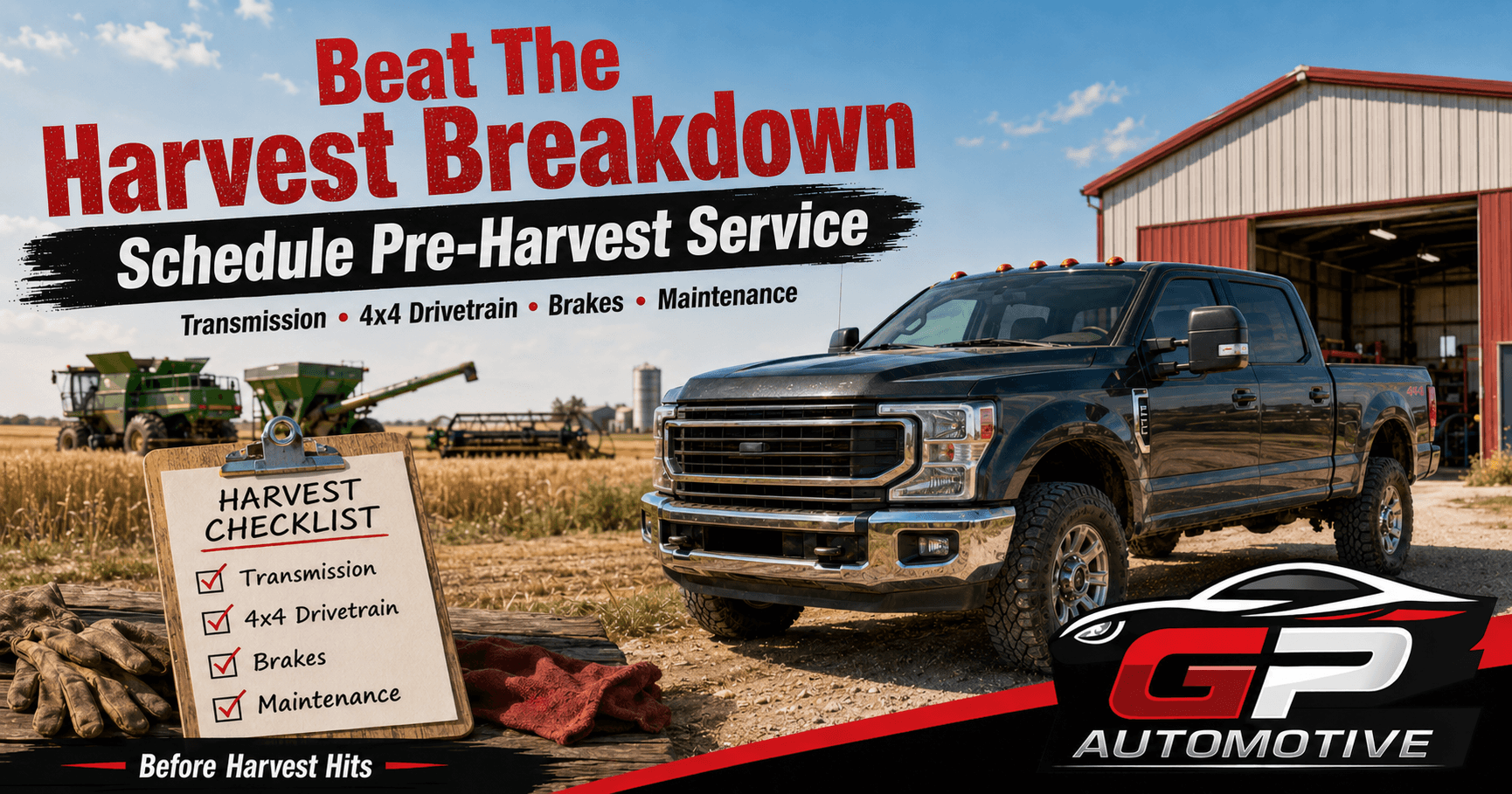
Harvest has a way of showing up like a marching band in a machine shed: loud, busy, unavoidable, and absolutely uninterested in whether your truck, transmission, brakes, or 4×4 drivetrain “meant to get looked at next week.”
For farm families, July is more than summer heat, county fairs, and dust on the windshield. It is the calm before the field battle. Once harvest starts, every vehicle on the farm suddenly has a job. Trucks haul seed, parts, tools, fuel, family members, lunch, paperwork, and sometimes a farmer who has had three hours of sleep and a gas station sandwich that may or may not count as food.
That is why July is the perfect time to schedule service for farm vehicles before harvest pressure begins. Routine maintenance is not just about changing oil or checking boxes. It is about protecting uptime, avoiding costly repairs, and keeping your operation moving when the weather window is open and the grain is ready.
National farm publications make the same point again and again: the small issue you ignore before the busy season can become the breakdown that stops everything. Farm Progress notes that preharvest equipment inspections can save time and money because a breakdown in the middle of harvest can bring work to an abrupt halt while parts, service, and repairs are sorted out Farm Progress. That logic does not stop with combines and tractors. It applies to the pickups, service trucks, grain-hauling vehicles, and 4×4 farm vehicles that keep the rest of the operation stitched together.
At GP Automotive, we see it every year: a small leak, a hard shift, a weak battery, a grinding brake, or a drivetrain noise gets pushed aside because “we’ll deal with it after things slow down.” Then harvest hits, things do not slow down, and suddenly that small issue has invited itself to the worst possible party.
So let’s talk about why pre-harvest vehicle maintenance matters, what can go wrong under high use, and how to conquer those nagging issues before they turn into expensive delays.
Harvest Is Hard On Farm Vehicles
Farm vehicles live a different life than daily commuters.
A town car may spend its day rolling down pavement, parking at work, and cruising home. A farm truck may start before sunrise, bounce across field entrances, idle beside equipment, tow fuel tanks, haul tools, crawl through mud, pull trailers, run gravel roads, carry heavy loads, and repeat the next day.
During harvest, those demands multiply. Short trips, heavy loads, dust, heat, stop-and-go movement, long idle times, rough terrain, and constant use all put extra strain on critical systems. The transmission works harder. The cooling system has less room for error. Brakes heat up faster. Batteries and alternators deal with repeated starts and electrical demand. The 4×4 drivetrain gets called into action when field conditions turn soft, slick, or unpredictable.
Routine maintenance gives you a chance to find weak points before those weak points get tested under pressure.
Think of it this way: maintenance is the preseason walk-through. Repair is often what happens after the whistle blows and something already broke.
Maintenance Is Cheaper Than Downtime
There are two kinds of repair bills. The first is the planned one, where a vehicle gets inspected, serviced, and repaired before the season turns frantic. The second is the emergency one, where the vehicle breaks down at the wrong time, the part is harder to get, the schedule is packed, and the truck is sitting instead of working.
The part may cost the same either way. The delay does not.
That is where farmers feel the real pain. A down vehicle during harvest can create a chain reaction. One truck being out may mean another truck has to cover double duty. A parts run takes longer. A trailer sits. A field crew waits. Grain movement slows. Someone has to leave the field to deal with a problem that could have been handled calmly two weeks earlier.
Farm Progress warns that lack of inspection before harvest can lead to standstills during harvest and negatively affect productivity Farm Progress. The American Farm Bureau Federation also emphasizes that farm work operates under time pressure, with farmers often working from sunup to sundown and moving equipment between fields and roads American Farm Bureau Federation. When the season is that tight, losing a dependable vehicle is more than inconvenient. It is operational drag.
Maintenance helps you buy down that risk.
No, it cannot prevent every breakdown. Farming has never been accused of being gentle on equipment. But routine service can catch the obvious troublemakers before they grow teeth.
The Nagging Issue Is Usually Trying To Tell You Something
Farmers are famous for listening to machines. A little whine, a new vibration, a different smell, a delayed shift, a steering pull, or a brake pedal that feels slightly off all tell a story.
The danger is getting used to the story.
That clunk in the drivetrain becomes “just what it does.” The check engine light becomes “probably a sensor.” The truck that hesitates going into gear becomes “fine once it warms up.” The brake noise becomes “we’ll get to it.” The oil spot in the driveway becomes “not too bad yet.”
The problem is that harvest does not make weak systems better. It exposes them.
Farm Progress recommends being proactive about rattles, grinding, dashboard warning lights, fluid levels, leaks, and other early warning signs before the busy season starts Farm Progress. That advice fits farm vehicles perfectly. The little warning signs are often your best chance to fix the issue while it is still manageable.
At GP Automotive, we would much rather help you diagnose a small concern in July than see you lose a critical vehicle during harvest.
Top Five Things That Can Go Wrong When Farm Vehicles Are Under High Use
Transmission Trouble
The transmission is one of the hardest-working systems in a farm vehicle. Towing, hauling, heat, field entrances, stop-and-go movement, and heavy loads all add stress. If the fluid is old, low, contaminated, or overheating, small problems can become expensive ones quickly.
Warning signs include hard shifting, delayed engagement, slipping, shuddering, whining, burning smells, leaks, or higher-than-normal RPMs before shifting.
Transmission service before harvest can help identify fluid issues, leaks, worn components, and performance concerns before the truck is working every day. Not every transmission concern means replacement. In many cases, early diagnosis gives you more options and may help prevent a major failure.
That matters because transmission replacement is not just expensive. It can also take a vehicle out of service when you need it most.
4×4 Drivetrain Problems
Farm vehicles often earn their keep when pavement ends. Four-wheel drive is easy to take for granted until the day you need it and it refuses to cooperate.
A 4×4 drivetrain includes components such as the transfer case, front differential, rear differential, driveshafts, axle components, U-joints, seals, and related fluids. Under high use, these systems deal with torque, uneven surfaces, moisture, dirt, mud, towing strain, and constant load changes.
Warning signs include clunking, grinding, vibration, difficulty engaging 4×4, fluid leaks, binding while turning, or noises that change under acceleration or deceleration.
A pre-harvest drivetrain inspection can help spot worn U-joints, leaking seals, low or dirty fluid, transfer case concerns, and differential issues. These are exactly the kinds of problems you want to find in the shop, not at the edge of a field with a loaded trailer and rain clouds arguing with the forecast.
Brake Wear And Stopping Distance
Farm trucks do a lot of stopping, often with weight behind them. Towing trailers, hauling equipment, carrying tools, and running gravel roads all put extra demand on brakes.
Brake wear does not always announce itself politely. Sometimes it squeaks. Sometimes it grinds. Sometimes the pedal gets soft. Sometimes the truck pulls. Sometimes stopping distance quietly increases until one day you realize the vehicle is not responding the way it should.
During harvest, braking performance is not just about avoiding repair costs. It is about safety. Farm vehicles may be moving near equipment, workers, bins, trailers, field entrances, and public roads. The American Farm Bureau Federation reminds drivers that farm equipment and vehicles create unique road safety risks, especially when large, slow-moving equipment is present American Farm Bureau Federation.
Before harvest, brake pads, rotors, calipers, brake lines, fluid condition, parking brake function, and overall stopping performance should be checked. If the truck is going to be heavy, busy, and tired by October, make sure the brakes are not already starting July half-defeated.
Cooling System And Fluid Failures
Heat is not friendly to farm vehicles. July and August temperatures, long idle times, slow field speeds, towing, dust, and heavy loads can push cooling systems hard.
A weak cooling system may show up as rising temperature, coolant smell, visible leaks, low coolant, crust around hose connections, a noisy fan, or poor heater performance when cooler weather arrives. Sometimes the first big sign is overheating, and by then the damage may already be underway.
Routine maintenance should include checking coolant level and condition, belts, hoses, radiator condition, fans, water pump signs, thermostat performance, and visible leaks. Other fluids matter too: engine oil, transmission fluid, brake fluid, power steering fluid, differential fluid, and transfer case fluid all play a role in keeping the vehicle alive under stress.
Farm Progress specifically points to hoses, fluid levels, leaks, and damp spots as issues worth finding before they become larger failures Farm Progress. For a farm truck, that simple advice can mean the difference between a planned service visit and a roadside problem.
Electrical, Battery, And Starting Issues
A farm vehicle that will not start has one job, and it has failed at it before breakfast.
Batteries, alternators, starters, wiring, sensors, grounds, lighting, trailer plugs, and charging systems all deserve attention before harvest. Farm use can be tough on electrical systems because dust, vibration, corrosion, rodents, moisture, and repeated starts all create opportunities for failure.
Warning signs include slow cranking, dim lights, intermittent electrical problems, warning lights, dead batteries, flickering dash lights, trailer light issues, or random starting trouble.
Modern vehicles also rely heavily on sensors and computer systems. Farm Progress notes that warning lights, error codes, sensors, and unresponsive systems should be reviewed before busy seasons Farm Progress. Ignoring those warnings can turn a simple diagnostic visit into a mystery hunt when time is short.
A pre-harvest electrical check can test the battery, alternator output, starting system, codes, wiring concerns, and lighting. And yes, trailer lights count. Nobody wants to discover a trailer wiring issue when the truck is already hooked up and the day is already behind schedule.
What A Smart Pre-Harvest Service Visit Should Include
A good farm vehicle checkup should be practical. It should focus on the systems most likely to affect uptime, safety, and repair cost during heavy use.
At GP Automotive, a pre-harvest service conversation may include:
- Transmission inspection and service recommendations
- 4×4 drivetrain inspection
- Differential and transfer case fluid checks
- Brake inspection
- Battery, alternator, and starting system check
- Fluid level and fluid condition review
- Belt and hose inspection
- Suspension and steering inspection
- Tire condition and pressure check
- Cooling system inspection
- Warning light and diagnostic scan
- General maintenance review based on mileage, use, and known issues
The goal is not to sell repairs you do not need. The goal is to help you understand what is urgent, what is coming due, and what can wait. A good diagnosis gives you choices. A breakdown usually takes choices away.
July Is The Sweet Spot
By the time harvest is underway, everyone is busy. Farmers are busy. Parts departments are busy. Shops are busy. Weather is busy being dramatic.
July gives you breathing room.
It is close enough to harvest that the service matters, but early enough that you may still have time to plan. If a truck needs brakes, drivetrain service, transmission attention, or a deeper repair, you have a better chance of handling it before harvest begins.
That is the point of preventive maintenance. You are not just fixing vehicles. You are protecting the rhythm of the farm.
A small July service bill can be a lot easier to stomach than a large October repair bill wrapped in downtime, stress, and delayed grain movement.
Do Not Let The Truck Vote Itself Off The Harvest Crew
Farm vehicles may not get the glamour of the combine, but they are part of the harvest team. When one goes down, the whole operation feels it.
So before harvest hits, listen to the nagging issues. Check the warning lights. Deal with the leak. Ask about the hard shift. Inspect the brakes. Service the drivetrain. Give that battery a fair trial before it chooses the coldest, busiest, most inconvenient morning to retire.
Harvest is hard enough without preventable vehicle problems jumping into the cab.
If your farm truck, service vehicle, or 4×4 has been working hard, schedule a July service appointment with GP Automotive. We will help you find the small issues before they become big ones, keep your vehicles ready for the season, and help you head into harvest with more confidence.
Because when the field battle begins, your truck should be ready to work, not sitting on the sidelines with a repair estimate.